
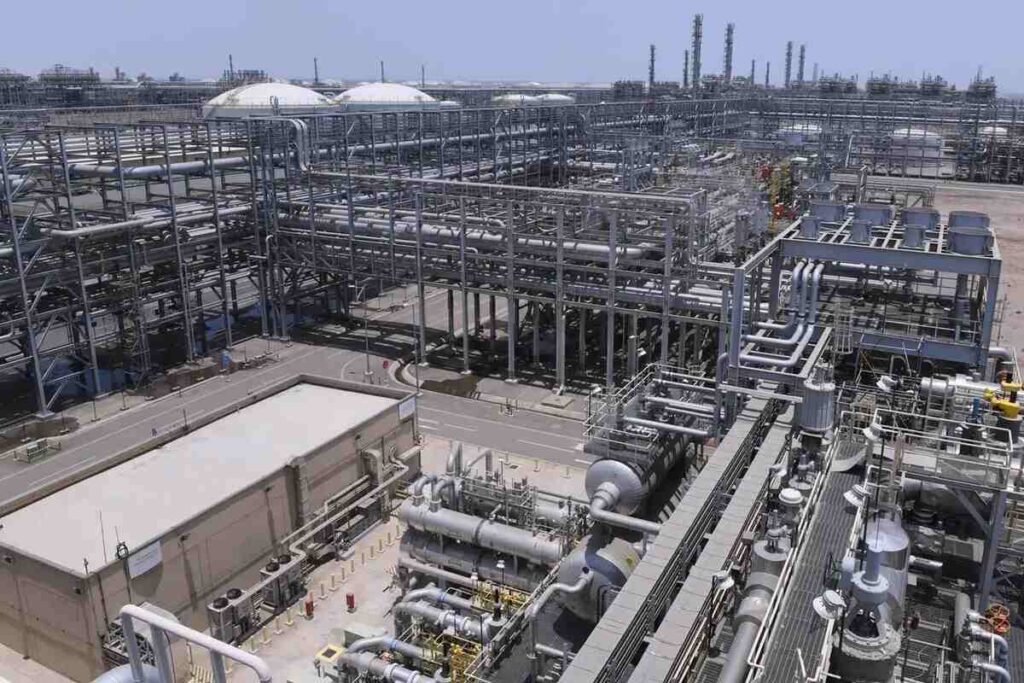
Chile’s emerging copper supply gas has altered how regional infrastructure and energy planning are being approached across the Southern Andes. In that environment, Argentina is being repositioned from a secondary mining jurisdiction into a potentially critical stabilizing supplier within the global copper economy. Copper is crucial in electric vehicle motors, renewable transmission infrastructure, wind turbine generators, solar installations, substations, transformers, and industrial electrification equipment. Copper mining intertwines with national energy infrastructure planning because modern mining operations need enormous and reliable power capacity. Mining operations also integrate with renewables such as solar generation, wind projects, hybrid microgrids, and energy storage systems. Large Andean copper projects depend on high-voltage transmission systems, substations, renewable generation integration, and desalination-linked pumping systems. These interconnections rely on robust components such as the socket clevis. Socket clevises serve as connectors linking high-voltage power lines to their supporting structures.
The socket clevis connects conductor cables to insulator strings on transmission towers. They provide a pivot point that allows lines to swing safely in high wind, preventing damage. Socket clevises serve as a dynamic connection in guyed poles and towers. They dissipate kinetic energy from wind and prevent metal fatigue in the ceramic insulators. The clevises serve in hydraulic systems, conveyor belt linkages, and haul truck hitches. They allow for the precise articulation of heavy machinery in rough terrain. Additionally, the clevises are anchor points for hoisting systems and substation hardware. They ensure stable load distribution and safe tension transfer in lifting operations. The socket clevis consists of materials that help withstand corrosion and high stress in the Andean region. Conducting quality assurance for the clevis ensures their operability and continuity in mining systems.
Quality assurance for socket clevises used in copper mining infrastructure
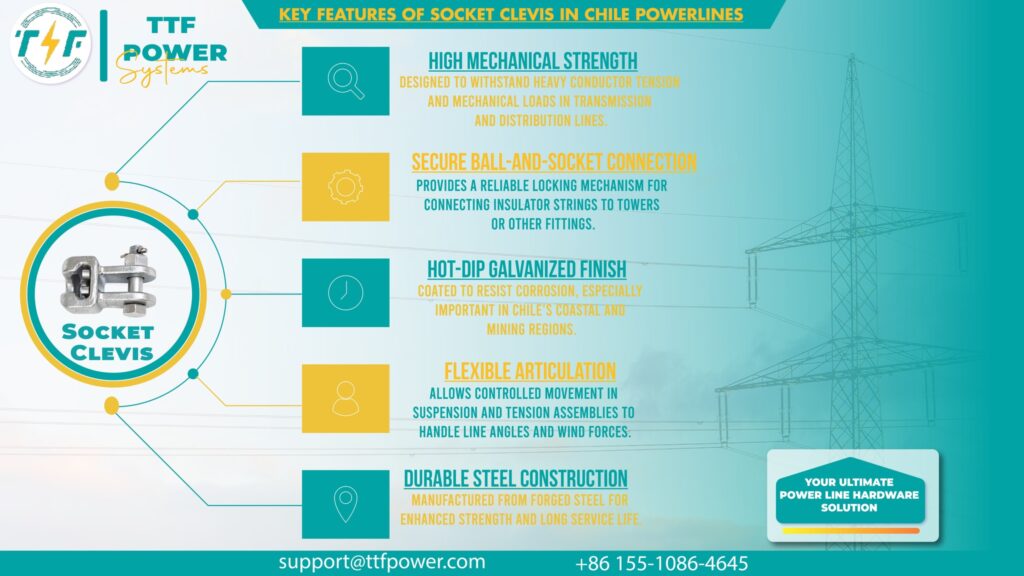
Conducting quality assurance for the socket clevis in copper mining infrastructure ensures structural reliability, mechanical safety, and operational continuity. Socket clevis operates under extreme tensile loading, vibration stress, corrosive exposure, and environmental fatigue. Quality assurance prevents failures that can create infrastructure risks across mining operations. Socket clevis quality assurance is crucial due to the growing dependence on high-voltage transmission systems, electrified processing infrastructure, and remote industrial support networks. Quality assurance begins by material integrity verification through chemical composition testing, grain structure tests, tensile strength tests, and impact resistance. The analysis confirms compliance with standards such as ASTM, IEC, ISO, and utility-grade transmission hardware specifications. Poor metallurgical consistency leads to brittle fracture, stress cracking, deformation, or fatigue failure under dynamic mining conditions. The process also includes dimensional accuracy testing, mechanical load and tensile testing, corrosion protection, pin and cotter security verification, and non-destructive testing.
The roles of socket clevis in copper mining infrastructure in Argentina.
Socket clevis fittings perform mechanical and structural functions within copper mining infrastructure in Argentina. They are crucial as Argentina expands transmission systems, renewable energy integration, and industrial electrification to support large-scale Andean mining development. Socket clevis fittings are connection elements within load-bearing assemblies that support power distribution, structural stability, and operational continuity across mining operations. Their key functions include:
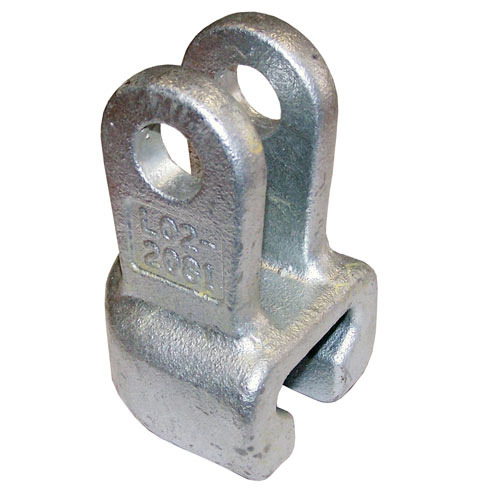
- Mechanical connection in transmission infrastructure – socket clevises connect insulator strings, suspension hardware, tension assemblies, conductor support systems, and transmission tower fittings. They maintain secure mechanical load transfer between energized transmission components.
- Supporting renewable energy integration – the socket clevis helps support the suspension and connection hardware that enables electricity transmission from renewable generation facilities to mining operations.
- Load transfer and structural flexibility – socket clevis assemblies distribute tensile loads between connected components while allowing rotational movement and alignment flexibility.
- Stabilization of guyed structures—the clevis fittings serve within guy wire systems, communication towers, and monitoring stations. It enables reliable articulation between guy wires, anchor systems, and structural supports.
Measures taken to expand infrastructure used in copper mining in the Andean region
The expansion of copper mining infrastructure is a priority driven by increasing global demand for copper in electrification, renewable energy systems, electric vehicles, and transmission networks. Argentina and other countries are implementing large-scale infrastructure measures to unlock remote mineral reserves, improve export capacity, and stabilize production growth. Modern Andean copper development depends on integrated systems involving power generation, transmission infrastructure, transport corridors, water supply systems, logistics networks, and telecommunications. Investments in Argentina’s infrastructure in the Andes functions as energy transition infrastructure, geopolitical resource planning, and industrial security investments. These measures serve as the foundations of the global electrified energy systems in Argentina’s mining sector.