
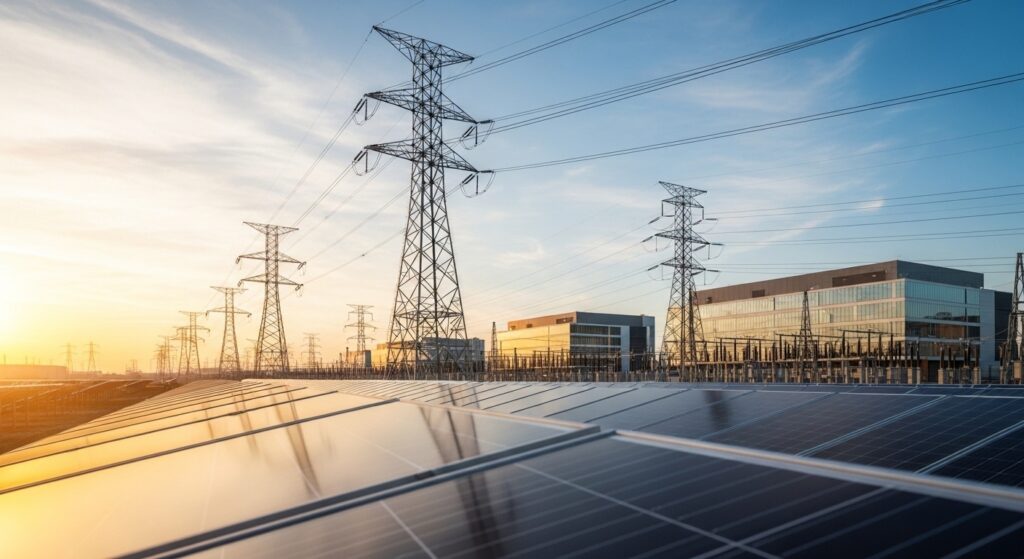
Peru’s electricity sector is currently entering a phase of investment focused on the expansion of generation and transmission infrastructure. At present, there are 33 power generation projects being built in the country. This signifies an investment of US$6.5 billion and is anticipated to contribute more than 5,000 MW of extra installed capacity from 2026 to 2036. The initiative includes 11 solar energy facilities, 5 wind energy sites, 16 hydroelectric projects, and 1 natural gas-powered power station. Furthermore, the mentioned 52 transmission projects signify over US$3 billion in investments. This generates a need for infrastructure like transmission poles, conductors, insulators, suspension and tension components, spiral vibration dampers, grounding gear, and surge protection devices. Transmission infrastructure offers the electrical route connecting generation sites to primary consumption regions. The transmission initiatives move electricity from newly built power facilities, enhance transmission capacity, ease network congestion, boost system reliability, and fortify the SEIN.
Spiral vibration dampers control wind-induced vibration in overhead power lines. They function by suppressing aeolian vibration. Aeolian vibration is a high-frequency and low-amplitude oscillation caused by steady winds creating vortices. This vibration can cause fatigue in the conductor strands at suspension clamps. A spiral vibration damper wraps around the conductor to prevent friction within the material. They protect conductors and ground wires that connect the generation facility to the grid. Spiral dampers mostly serve on optical ground wire (OPGW) and all-dielectric self-supporting (ADSS) cables. Their helical design distributes pressure and avoids the point loads that may damage the optical fibers.
Quality assurance for spiral vibration dampers used in Peru’s power generation projects
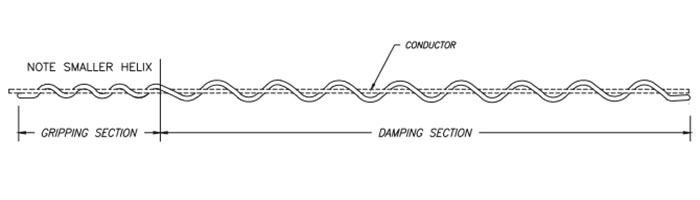
Spiral vibration dampers reduce aeolian vibration of conductors and shield wires. They limit fatigue damage at suspension and tension points, clamps, fittings, and conductor strands. Quality assurance covers the chain from design selection and material control through factory testing, installation, and commissioning. The process covers correct damper section, material quality, dimensional inspection, mechanical performance, and vibration-performance verification. During spiral vibration damper installation, QA verifies the correct conductor and damper model, the correct installation location, the correct orientation, the correct number of dampers, and no conductor strand damage. Quality assurance helps ensure proper design verification, qualification testing, production QA, and installation control.
Functions of spiral vibration dampers in Peru’s power generation projects
Spiral vibration dampers control wind-induced vibrations of conductors and shield earth wires. This is crucial where electricity generated by hydroelectric, solar, wind, thermal, or other generating facilities must be transported over long routes. Here are the roles of the spiral vibration dampers in the infrastructure.
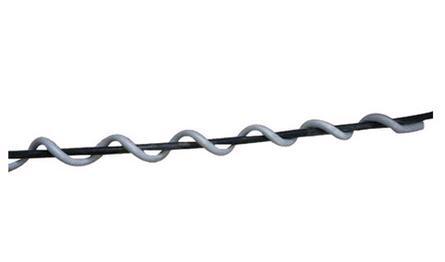
- Suppression of aeolian vibration—the vibration damper reduces aeolian vibration in the infrastructure. It does this by absorbing and dissipating the vibration energy. The damper reduces the amplitude and severity of conductor movement.
- Protection against conductor fatigue—spiral vibration dampers can help extend the service life of conductors. They prevent strand fatigue, broken conductor wires, fretting and abrasion, damage near clamps, and conductor failure.
- Protection of suspension and tension fittings—vibration affects suspension clamps, tension clamps, splices, and ground-wire fittings. The damper helps limit the mechanical stress transmitted to these components.
- Improving transmission-line reliability—spiral vibration dampers ensure reliability by reducing the probability of failures. They ensure the reliability of the overhead line to the generation project’s availability.
- Protection of shield and earth wires—spiral dampers serve on overhead earth wires where conductors and line design call for them. They contribute to lightning shielding, grounding, fault-current paths, and telecommunications.
Peru’s investments in power generation promote energy efficiency
Peru’s investment in electricity generation goes further than simply increasing supply. These investments can enhance Peru’s energy efficiency in various interconnected manners. This occurs via:
- Boosting the proportion of effective renewable generation—solar and wind power transforms accessible energy sources into electricity without requiring fuel burning.
- Minimizing energy losses via transmission infrastructure—enhanced modern transmission systems boost efficiency by raising transfer capacity, alleviating network congestion, optimizing voltage management, and linking renewable sources to demand areas.
- Enhancing the use of Peru’s renewable resources—these investments enable the nation to convert a greater part of its local resources into valuable electricity.
- Expanding the generation portfolio—the investment integrates solar, wind, hydropower, and natural gas. This contributes to enhancing the operational effectiveness of the electricity system.
- Enhancing grid reliability and minimizing inefficient operational conditions—Peru‘s electricity plan focuses on establishing a dependable, consistent, and efficient electricity system.