
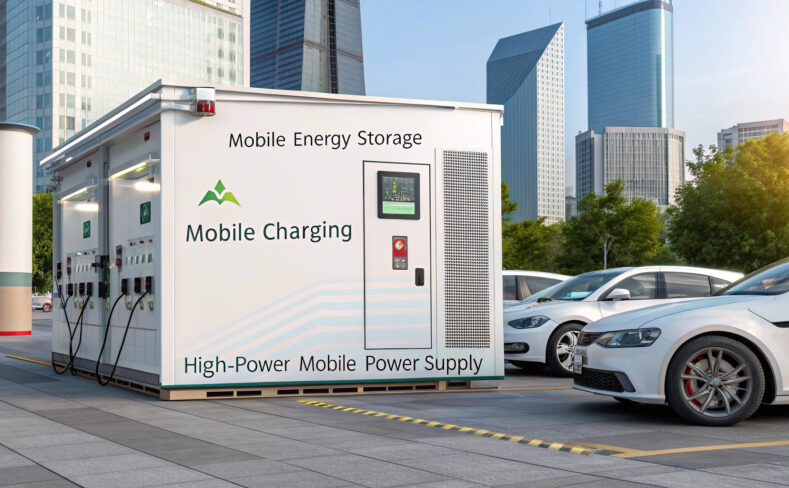
Tesla and YPF Argentina recently signed a letter of intent focusing on electric vehicle infrastructure, battery storage, and charging networks. Tesla can leverage its expertise in charging infrastructure and energy storage systems to establish a long-term presence. This will allow the company to build supporting infrastructure before large-scale vehicle adoption. Argentina’s YPF already has service stations that occupy strategic positions along highways, urban centers, and commercial corridors. Converting these stations into EV charging hubs would reduce deployment costs. Tesla’s supercharger technology is prominent for its high charging speeds, network reliability, and integrated software management. Integration with BESS is also crucial as Argentina expands wind and solar generation. Tesla’s Megapack technology could complement YPF’s existing and future renewable assets. This is by improving grid stability, reducing demand pressures, and increasing renewable energy use. This infrastructure uses robust line hardware such as aerial suspension clamps.
Aerial suspension clamps support the physical and digital infrastructure needed for Argentina’s electric vehicle ecosystem. They are critical in on-site generation, smart infrastructure, and grid integration. The clamps support and protect the power and data cables on which EV charging, BESS, and the grid depend. Aerial suspension clamps distribute the weight of conductors and mechanical loads to prevent stress and damage to cables and support structures. The clamps grip and support conductors on poles and distribute the mechanical loads to prevent damage from conductor weight. Additionally, they allow controlled movement due to thermal expansion and contraction. This reduces mechanical strain and prevents conductor fatigue.
Quality assurance for aerial suspension clamps used in Argentina’s EV networks
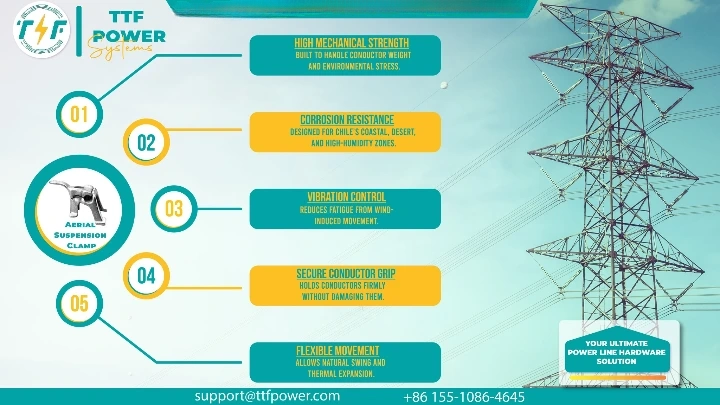
Argentina is expanding the EV charging networks, BESS, renewable energy plants, and smart grid infrastructure. This relies on the reliability of overhead power distribution systems. Aerial suspension clamps support and secure conductors on overhead distribution and transmission lines supplying electricity to these facilities. Conducting quality assurance for the clamps ensures long-term performance, safety, and grid reliability. QA also ensures reliable EV charging operations, supports BESS, enhances renewable energy integration, and supports smart grid technologies. The QA process for aerial suspension clamps includes raw material verification, precision manufacturing, mechanical and fatigue testing, and non-destructive inspection. The clamp also undergoes electrical performance evaluation, corrosion protection, and compliance with international standards. Quality-assured aerial suspension clamps are essential for building resilient, efficient, and sustainable power infrastructure.
The roles of aerial suspension clamps in Argentina’s EV networks
Aerial suspension clamps suspend and support conductors from poles while maintaining their mechanical stability and electrical performance. They support overhead power networks that supply electricity to these facilities. Here are their key functions in the electric vehicle ecosystem.

- Supporting overhead conductors—Aerial suspension clamps suspend electrical conductors from insulators mounted on utility poles. This enables distribution and transmission lines to deliver electricity from substations to the systems.
- Distributing mechanical loads – suspension clamps distribute mechanical forces acting on conductors to prevent stress at individual connection points.
- Maintaining proper conductor position – suspension clamps maintain conductor alignment, preserve conductor spacing, and maintain ground clearances.
- Protecting conductors from mechanical damage – the clamps grip conductors without causing compression or abrasion. This helps prevent conductor strand deformation, surface wear, and fatigue damage.
- Supporting smart grid technologies—aerial suspension clamps support smart grids by maintaining reliable electrical pathways, consistent line performance, and secure mounting. Stable mechanical infrastructure enables advanced monitoring and grid management technologies.
Roles of the electric vehicle ecosystem in Argentina’s decarbonization goals
Argentina is focused on energy transition to reduce greenhouse gas emissions, improve energy security, and increase the share of renewable energy in its electricity mix. The development of a sustainable EV ecosystem in Argentina plays a critical role in achieving these decarbonization goals. Here is the importance of the EV ecosystem in Argentina.
- Reducing greenhouse gas emissions from transportation – the expansion of the EV ecosystem decarbonizes the transport sector. This is by replacing internal combustion engines, lowering carbon dioxide emissions, and improving energy efficiency.
- Increasing use of renewable energy – the EV ecosystem supports renewable energy by charging vehicles using renewable electricity and increasing demand for clean power generation.
- Strengthening the domestic lithium value chain – Argentina’s vast lithium resources are important for local battery manufacturing, reducing battery import dependence, and creating value-added industries.
- Encouraging investment in clean energy infrastructure—the growth of the EV ecosystem stimulates investment in infrastructure such as smart grid technologies, renewable energy plants, battery storage facilities, and transmission and distribution networks.